

Back in the spring of 1999, Britain’s Chancellor of the Exchequer Gordon Brown decided that gold was finished.
It seemed to make sense at the time.
After all, gold didn’t yield anything, nor did it grow.
The precious metal just sat in its vault, completely useless in a world of sophisticated financial instruments, interest-bearing bonds, and the shiny new euro.
Why would a modern central bank hold half its reserves in yellow metal when it could hold Treasuries instead?
So Brown sold it.
Over the next three years, the British government auctioned off 395 metric tons of gold — roughly half the U.K.’s entire reserve — in 17 separate sales, at prices that ranged from $256–$296 per ounce.
But Brown made one decision that transformed a bad idea into a legendary disaster: He announced the sales in advance.
That means that every trader on Earth knew precisely when the auctions were happening, and immediately knew exactly how much gold was coming to market.
The price collapsed before the first bar was sold.
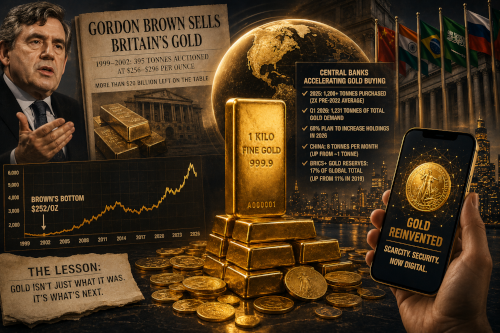
That day, gold bottomed out at $252/oz when Brown’s first sale hit the market.
In trading circles, it became known as “Brown’s Bottom” — not affectionately, either.
And it turns out that the British Treasury left more than $20 billion on the table.
For the record, this represents one of the most expensive opinions a finance minister ever held.
But here’s the thing about Brown’s logic — it wasn’t all that crazy.
You see, this was actually the consensus view of every sophisticated financial institution in 1999.
To them, gold was a relic, and paper was the future: Treasuries, bonds, and sophisticated instruments managed by central banks that understood how the modern economy worked.
Of course, that consensus was completely, catastrophically wrong… and the reason why tells us everything about where gold is heading next.
The truth is, gold’s climb from Brown’s Bottom wasn’t a straight line.
This move took years to find its footing, then accelerated through the 2008 financial crisis before peaking near $1,900/oz in 2011.
Gold spent the next decade consolidating.
Then something changed.
The Best Free Investment You’ll Ever Make
Join Gold World today for FREE. Get the latest insight on gold, silver, and precious metals delivered straight to your inbox. When you become a member today, you’ll get our latest free report: “The #1 Golden Token to Buy Now.” Don’t Delay!
After getting your report, you’ll begin receiving the Gold World e-Letter, delivered to your inbox daily.
During COVID, gold broke out in a way most investors still haven’t fully processed, and hit $2,000/oz for the first time.
By 2024, gold prices crossed above $3,000/oz and topped out at $5,589/oz last January.
The pullback since then has brought prices back down to $4,200/oz — roughly 22% off its January 28th peak. I’ll note that even after the correction, gold prices are still up nearly 30% year-over-year.
But here’s what matters: Wall Street expects more!
Goldman reaffirmed a $5,400/oz year-end target during that pullback, and JP Morgan forecasts stuck to their $6,000/oz 2027 target, while Morgan Stanly is expecting a short-term run back over $5,200/oz by year-end.
In other words, nobody on Wall Street is debating whether gold goes back above $5,000/oz.
The debate is how far gold prices will climb.
At $4,200/oz today, those targets represent a 20-43% upside sitting on the table during a pullback driven by profit-taking — not by any change in the structural thesis that got us here.
So what is that thesis?
Well, it all goes back to one weekend in February 2022.
On February 26th, 2022, Western governments froze approximately $300 billion in Russian central bank assets.
These weren’t oligarch’s yachts that were being held, nor were they private cash accounts.
These assets were official foreign exchange reserves of a sovereign government — dollar-denominated Treasuries and euro-denominated bonds.
The exact type of paper assets Gordon Brown had been swapping for gold in 1999.
Frozen overnight… gone and inaccessible.
Now imagine you’re the finance minister of China, India, Brazil, Saudi Arabia, or Turkey and just watched $300 billion disappear by political decree.
So let me ask, “what’s your first move on Monday morning?”
You call your team and ask how much of your country’s reserves could be frozen the same way — then you start buying gold.
Why? Because gold has something no Treasury bond, no euro account, and no dollar reserve will ever have.
Gold doesn’t have an issuer or counterparty… or any government to sanction, for that matter.
If you hold the metal, you hold the value.
Full stop.
Since that weekend, gold buying has been relentless.
Central banks globally purchased more than 1,200 tonnes of gold in 2025 — more than double the pre-2022 annual average of 400 to 500 tonnes.
In the first quarter of 2026 alone, total gold demand hit 1,231 tonnes.
In fact, the World Gold Council’s March 2026 survey found that 68% of central banks plan to increase their gold holdings further in 2026.
By the way, they didn’t say maintain — they said increase.
And if you’re keeping track, you’ll find that BRICS+ nations now hold over 17% of global gold reserves, up from about 11% in 2019.
China ramped its buying from roughly one tonne per month to eight tonnes per month by April 2026.
Look, these are sovereign treasuries making decade-long reserve allocation decisions. And when a central bank moves into gold, it doesn’t move in for a quarter and rotate out. It holds. And it keeps buying.
They’re long-term players, and you can bet they’ll keep buying.
But there’s a little problem here.
Supply just isn’t keeping up.
New mine development takes 15 to 20 years. Mine production grew just 2% year-over-year in Q1 2026. There’s no transformative new supply coming online, and the only response is higher output from existing operations.
This is the structural setup Brown couldn’t see from 1999, a world where the largest single buyer class — sovereign governments — is accelerating purchases driven by geopolitical logic that has nothing to do with the gold price itself.
They’re not buying because gold went up, but rather because they watched $300 billion disappear and concluded that the dollar-centric reserve system has a vulnerability they can’t afford to ignore.
That logic doesn’t go away when the gold price pulls back.
Gold’s Evolution has Finally Come
Now here’s where the gold story gets genuinely interesting for the next decade — and I’ll tell you now that it has nothing to do with vaults or miners.
Remember, gold has been the same asset more or less for 2,600 years.
You hold it, lock it up, and trade it through a broker. The metal earns nothing, moves slowly, and the friction of ownership has always been its primary limitation.
For most of human history, that was fine because there was no alternative.
That’s changing now.
For the first time, the properties that make gold irreplaceable — scarcity, no counterparty risk, no issuer, no debasement — are being encoded into digital instruments that move at the speed of money.
This isn’t a mere substitute for gold, it’s a new form of it.
What’s being built right now is something entirely different, and takes 2,600 years of gold’s proven store-of-value track record and makes it programmable, portable, and accessible to anyone on Earth with a phone.
The infrastructure for this is being laid during a gold bull market that every major bank on the planet says isn’t close to over.
And the investors who understand what’s being built — and position in it before the herd figures out that this is the next chapter of the gold story — are going to look back on 2026 the same way early gold buyers look back on Brown’s Bottom.
The British government sold the bottom at $252/oz because they didn’t understand what gold actually was.
You don’t have to make the same mistake.
Stay tuned.
Until next time,

Keith Kohl
 Check us out on YouTube!
A true insider in the technology and energy markets, Keith’s research has helped everyday investors capitalize from the rapid adoption of new technology trends and energy transitions. Keith connects with hundreds of thousands of readers as the Managing Editor of Energy & Capital, as well as the investment director of Angel Publishing’s Energy Investor and Technology and Opportunity.
For nearly two decades, Keith has been providing in-depth coverage of the hottest investment trends before they go mainstream — from the shale oil and gas boom in the United States to the red-hot EV revolution currently underway. Keith and his readers have banked hundreds of winning trades on the 5G rollout and on key advancements in robotics and AI technology.
Keith’s keen trading acumen and investment research also extend all the way into the complex biotech sector, where he and his readers take advantage of the newest and most groundbreaking medical therapies being developed by nearly 1,000 biotech companies. His network includes hundreds of experts, from M.D.s and Ph.D.s to lab scientists grinding out the latest medical technology and treatments. You can join his vast investment community and target the most profitable biotech stocks in Keith’s Topline Trader advisory newsletter.


